
You spend weeks running an aggressive link-building campaign, in a couple of days, and see your ranking rocket to new heights. Then comes the inevitable crash, when all the hard work you put in gets undone because your website suddenly stops receiving traffic, and no amount of troubleshooting can help you figure out the reason behind this.
Unfortunately, such stories repeat themselves on a daily basis, and the problem causing them always remains the same, unnatural link velocity. In this article, we’ll explain in detail what link velocity is, why it’s considered by Google to be one of the most important ranking factors, and most importantly, how to establish a sustainable link-building process that won’t bring down all of your hard work to naught after just one algorithm update.
What you will learn:
- What is link velocity, and why is it critical for long-term rankings?
- The difference between natural and unnatural velocity
- Healthy link acquisition’s benchmark numbers
- 7 proven strategies to stay in the safe zone
- Tools to monitor your velocity
- How to recover if you have already crossed the line
What is Link Velocity? (And Why Most SEOs Get It Wrong)
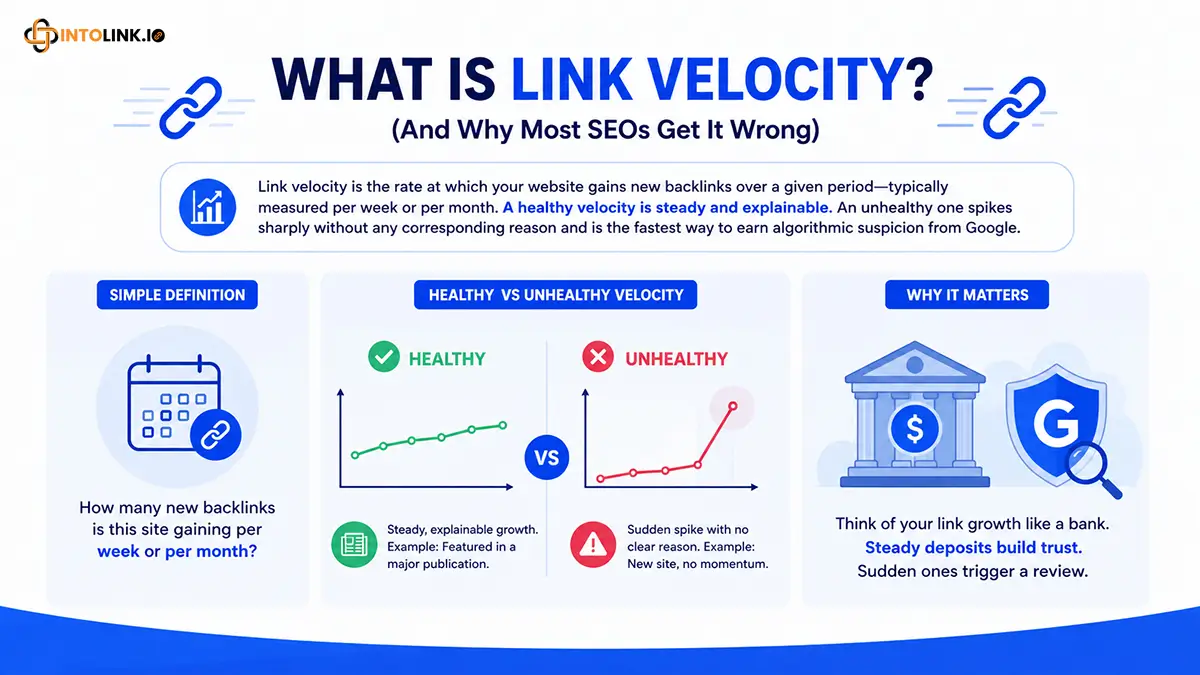
Link velocity is the rate at which your website gains new backlinks over a given period—typically measured per week or per month. A healthy velocity is steady and explainable. An unhealthy one spikes sharply without any corresponding reason and is the fastest way to earn algorithmic suspicion from Google.
Simple Definition of Link Velocity
At its simplest, link velocity answers one question: How many new backlinks is this site gaining per week or per month?
But the number alone tells you very little. A site gaining 50 new referring domains in a week might be perfectly healthy if it just got featured in a major publication. That same number for a brand-new site with no content momentum would be a serious red flag. Context is everything, and Google has become extremely sophisticated at reading that context.
Think of your link growth the way a bank thinks about transaction patterns. Steady, predictable deposits build trust over time. A sudden large deposit from an unknown source triggers a compliance review. Google’s algorithms work the same way.
Natural vs Unnatural Link Velocity—The Real Difference
The distinction is not about speed. It is about pattern and plausibility. A site can grow fast and still appear natural. A site can grow slowly and still look manipulated. What matters is whether the pattern of growth reflects genuine interest from real people and real publishers.
| Velocity Type | Growth Pattern | Google’s Likely Response |
| Natural | Gradual, consistent month-over-month growth | Trust accumulates steadily |
| Unnatural | Sharp spike followed by a plateau or drop, low-quality sources | Algorithmic or manual review
triggered |
| Stagnant |
No new links for extended periods, then a burst |
Pattern inconsistency raises
suspicion |
Why Natural Link Velocity Matter for Google Rankings?
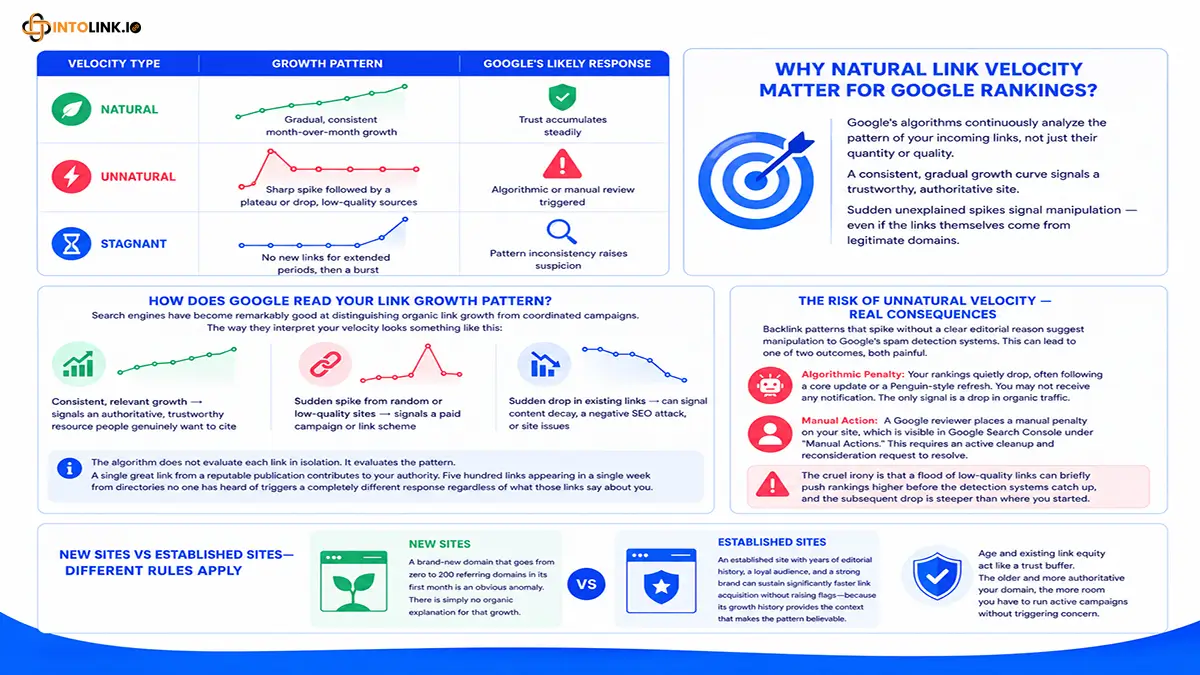
Google’s algorithms continuously analyze the pattern of your incoming links, not just their quantity or quality. A consistent, gradual growth curve signals a trustworthy, authoritative site. Sudden unexplained spikes signal manipulation — even if the links themselves come from legitimate domains.
How Does Google Read Your Link Growth Pattern?
Search engines have become remarkably good at distinguishing organic link growth from coordinated campaigns. The way they interpret your velocity looks something like this:
- Consistent, relevant growth → signals an authoritative, trustworthy resource people genuinely want to cite
- Sudden spike from random or low-quality sites → signals a paid campaign or link scheme
- Sudden drop in existing links → can signal content decay, a negative SEO attack, or site issues
The algorithm does not evaluate each link in isolation. It evaluates the pattern. A single great link from a reputable publication contributes to your authority. Five hundred links appearing in a single week from directories no one has heard of triggers a completely different response regardless of what those links say about you.
The Risk of Unnatural Velocity — Real Consequences
Backlink patterns that spike without a clear editorial reason suggest manipulation to Google’s spam detection systems. This can lead to one of two outcomes, both painful.
- Algorithmic Penalty: Your rankings quietly drop, often following a core update or a Penguin-style refresh. You may not receive any notification. The only signal is a drop in organic traffic.
- Manual Action: A Google reviewer places a manual penalty on your site, which is visible in Google Search Console under “Manual Actions.” This requires an active cleanup and reconsideration request to resolve.
The cruel irony is that a flood of low-quality links can briefly push rankings higher before the detection systems catch up, and the subsequent drop is steeper than where you started.
New Sites vs Established Sites—Different Rules Apply
A brand-new domain that goes from zero to 200 referring domains in its first month is an obvious anomaly. There is simply no organic explanation for that growth. However, an established site with years of editorial history, a loyal audience, and a strong brand can sustain significantly faster link acquisition without raising flags—because its growth history provides the context that makes the pattern believable.
Age and existing link equity act like a trust buffer. The older and more authoritative your domain, the more room you have to run active campaigns without triggering concern.
What Does a “Natural” Link Growth Curve Actually Look Like?
A natural link growth curve is a steady upward slope—not a hockey stick. Research suggests that the average top-ranking domain gains roughly 48 new referring domains per month. Occasional justified spikes (from press mentions, viral content, or product launches) are acceptable and even expected, as long as they are explainable.
The Benchmark Numbers You Should Know
Average top-ranking domains gain approximately 48 new referring domains per month.
For a site already sitting at 200 referring domains, that benchmark means roughly 12–20 new referring domains per month is a healthy, sustainable pace. Gaining 100 new links in a single week would be wildly out of proportion a pattern Google would almost certainly flag for review.
But these numbers are averages, not ceilings. What matters most is that your current velocity is consistent with your historical trend. A 30% month-over-month increase is generally considered sustainable. A 300% spike in a single month demands a very good explanation.
When are “Sudden Spikes” Are Completely Fine?
Google does not penalize fast growth. It penalizes unexplained fast growth.
Imagine a startup that launches a new product, gets covered by TechCrunch, and picks up 150 new backlinks over 48 hours. That is a perfectly natural spike, it is traceable to a single editorial event. Google can connect the dots. Contrast that with a site that gains 150 backlinks over 48 hours from a mix of irrelevant directories and foreign-language blogs. There is no editorial story. That is the kind of spike that triggers scrutiny.
The practical implication, if you plan a Digital PR campaign, a product launch, or a viral content push, expect a spike and do not be afraid of it. The spike becomes a problem only when there is no real-world story to justify it.
7 Proven Strategies to Maintain Natural Link Velocity
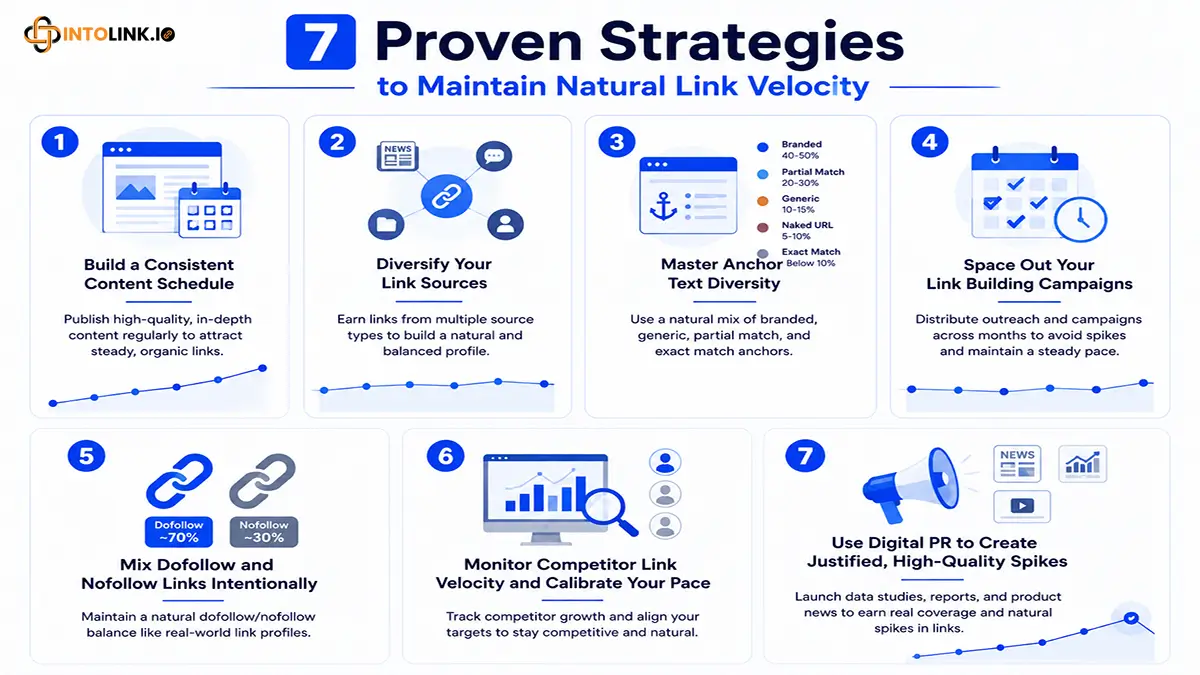
The core of natural link velocity management is consistency, diversity, and pacing. The strategies below work together to create a link profile that looks and behaves exactly like the profile of a site that earns links through genuine authority — because that is ultimately what it becomes.
1. Build a Consistent Content Publishing Schedule
Links follow content. When you publish high-quality content on a predictable schedule, you create a steady stream of new material that other websites, journalists, and researchers want to reference. This is the most organic link-building mechanism that exists.
Evergreen content guides, research studies, data compilations, and how-to resources — consistently outperform timely content in generating long-term backlinks. A well-researched guide published today can still be earning new referring domains two years from now. That kind of sustained, slow-burn link acquisition is exactly what a natural velocity curve looks like.
Practical action: Commit to publishing at least two substantive, well-researched pieces per month. Prioritize depth and original data over volume. One excellent resource that earns 30 organic links beats ten thin posts that earn none.
2. Diversify Your Link Sources (Never Over-Index on One Type)
A healthy backlink profile draws from multiple source categories: editorial blog posts, news coverage, industry directories, niche forums, social platforms, podcast show notes, academic citations, and resource pages. Over-concentration in any single category is a reliable signal of an artificial campaign.
If 80% of your links come from guest posts on similar-looking blogs, that pattern is visible to Google — and it looks exactly like what it is: a coordinated outreach campaign rather than organic editorial interest. Diversity is not just a best practice; it is protective camouflage.
Practical action: Map your current link sources by category. If any single type represents more than 40% of your profile, actively work to introduce links from other source categories before continuing to build in your dominant area.
3. Master Anchor Text Diversity
The words used to link to your site are just as revealing as where the links come from. A profile dominated by exact-match commercial keywords is a classic fingerprint of manipulative link building. Real editors and real readers link to content using a natural variety of anchor styles.
| Anchor Text Type | Recommended Range | Example |
| Branded | 40–50% | “YourBrand” or “YourBrand.com” |
| Partial Match | 20–30% | “link building tips for YourBrand” |
| Generic | 10–15% | “click here”, “read more” |
| Naked URL | 5–10% | “https://yourbrand.com/guide” |
| Exact Match Keyword | Below 10% | “best SEO tool for small business” |
Branded anchors should dominate a natural profile. When real people recommend a site, they typically reference the brand name—not the target keyword. Keep exact-match anchors deliberately sparse.
4. Space Out Your Link Building Campaigns
Bulk outreach executed all at once creates the worst possible velocity pattern — a sharp spike followed by silence. Instead, spread your campaigns across the calendar like a professional media company plans its editorial output: steadily, deliberately, and with clear monthly targets.
A useful rule of thumb: if a single campaign would push your monthly link acquisition more than 200–300% above your established baseline, split it across multiple months. The links are equally valuable whenever they arrive. The pattern in which they arrive is what Google is watching.
Practical action: Set a monthly referring domain target based on your historical average. Plan outreach campaigns to hit that target consistently — neither falling far below it nor spiking dramatically above it without a PR-driven reason.
5. Mix Dofollow and Nofollow Links Intentionally
A backlink profile made up entirely of dofollow links is inherently artificial. In the real world, a substantial portion of links pointing to any site come from sources that naturally pass nofollow attributes—social media platforms, forum threads, blog comments, Wikipedia citations, and press release syndication.
A roughly 70/30 split between dofollow and nofollow links mirrors what a genuinely popular site accumulates naturally. Pursuing only dofollow links (as many SEOs do) gradually shifts your ratio in a direction that looks increasingly engineered.
Practical action: Do not ignore nofollow link opportunities. Contributing to industry forums, responding to journalist queries, and maintaining active social profiles all generate nofollow links that improve your profile’s overall believability.
6. Monitor Competitor Link Velocity and Calibrate Your Own Pace
Your link velocity does not exist in a vacuum. It exists in the context of your competitive landscape. If the top three competitors in your niche are gaining 30–40 new referring domains per month, that is the pace you need to match or exceed to maintain competitive positioning over time.
Use tools like Ahrefs or Semrush to track the monthly referring domain growth of your top five competitors. This tells you both the minimum pace required to remain competitive and the upper boundary of what looks normal within your niche.
Practical action: Once a quarter, audit the link velocity of your top five competitors. Adjust your monthly targets accordingly. If a competitor is accelerating, understand why — they may have launched a PR campaign or a linkable asset worth studying.
7. Use Digital PR to Create Justified, High-Quality Spikes
The most powerful link-velocity strategy is also the most sustainable one: create genuine reasons for people to write about you. Digital PR — including data-driven studies, product launches, expert commentary, and newsjacking — generates the kind of editorial coverage that produces large, fast link acquisition spikes that Google not only tolerates but rewards.
A well-executed Digital PR campaign can generate 50–200 new referring domains in a short window. Because these links come from legitimate editorial sources writing about a newsworthy event, the velocity spike is completely justifiable. Google can trace the story. The links are real. The growth is fast but authentic.
Practical action: Plan at least two Digital PR pushes per year—a data study, an industry report, or a product announcement. These create the justified spikes that give your velocity curve its natural, non-linear character, while the steady baseline work fills in the space between them.
How to Monitor Your Link Velocity (Tools and Process)
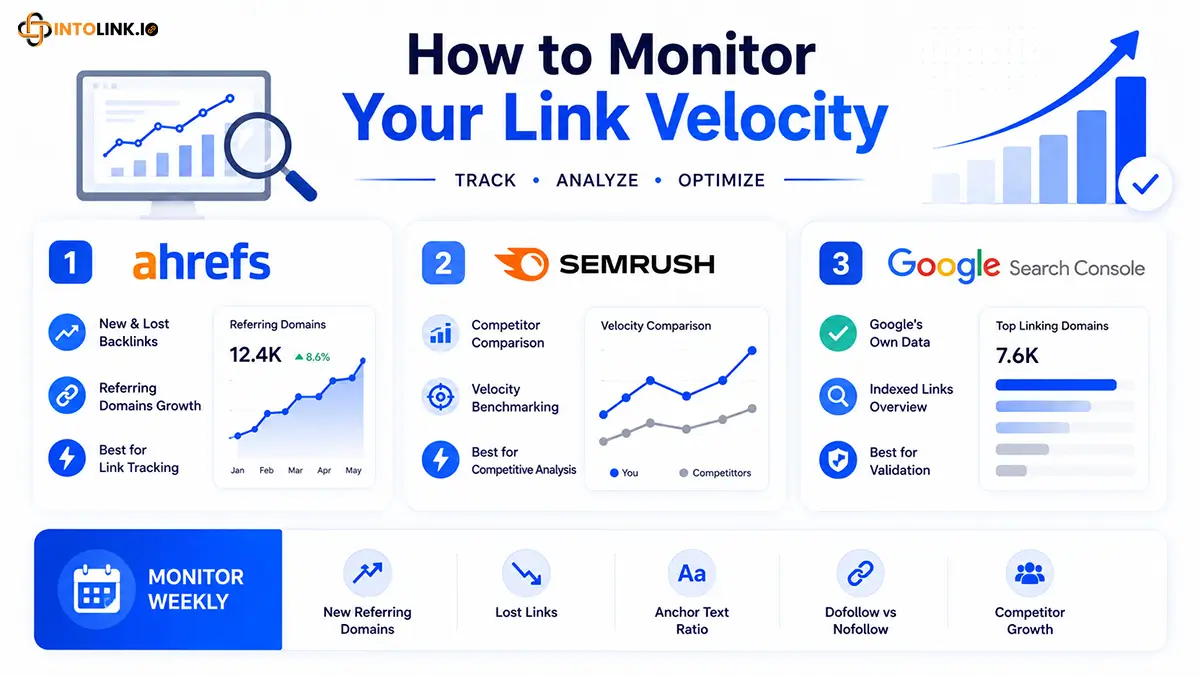
Effective link velocity monitoring requires tracking new and lost referring domains on a weekly basis using dedicated SEO tools. The goal is to spot anomalies before they become problems both unexpected spikes you did not plan and unexpected drops that might indicate a negative SEO attack or link decay.
Best Tools to Track Link Velocity
Ahrefs is the most comprehensive option for backlink analysis. Its “New and Lost Backlinks” report lets you see exactly which referring domains appeared or disappeared within any date range. The referring domains graph gives you a clear visual of your growth curve over time—an essential check to run at least monthly.
Semrush’s Backlink Analytics complements Ahrefs by providing a different index and a cleaner comparison tool. Its ability to overlay your velocity against a competitor’s makes it ideal for the competitive benchmarking strategy described above.
Google Search Console is the most authoritative source for understanding which links Google has actually indexed and is counting. The Links report shows your top linking domains and the distribution of your anchor text — a useful sanity check against what your third-party tools show.
What Metrics to Track Weekly and Monthly
Weekly/Monthly Monitoring Checklist:
- New referring domains gained (week-over-week comparison)
- Lost or dropped links (are you losing ground to link decay?)
- Anchor text ratio breakdown (is exact-match creeping up?)
- Link source category distribution (blogs vs news vs directories vs social)
- Dofollow vs nofollow ratio (staying near a 70/30 split?)
- Spam score or toxic link percentage (catch negative SEO early)
- Competitor velocity comparison (are top competitors accelerating?)
Red Flags — Signs Your Link Velocity Has Gone Unnatural
The clearest red flags in a link velocity pattern are unexplained spikes from low-quality sources, a sharp over-concentration of commercial exact-match anchor text, and links originating from known link networks or penalized domains. Any one of these can trigger algorithmic scrutiny. All of them together almost certainly will.
Warning Signs to Watch For
A high volume of links arriving simultaneously from domains with no topical relevance to your industry
Anchor text distribution where commercial terms dominate (above 40–50% exact-match)
Links from domains that are part of known private blog networks (PBNs) or link farms
A sharp velocity spike with no corresponding content event, PR mention, or product launch to explain it
Many links from the same C-class IP range (a classic footprint of a link network)
A sudden loss of 20%+ of referring domains, which may indicate a negative SEO campaign in progress
Common Mistakes That Destroy Natural Velocity
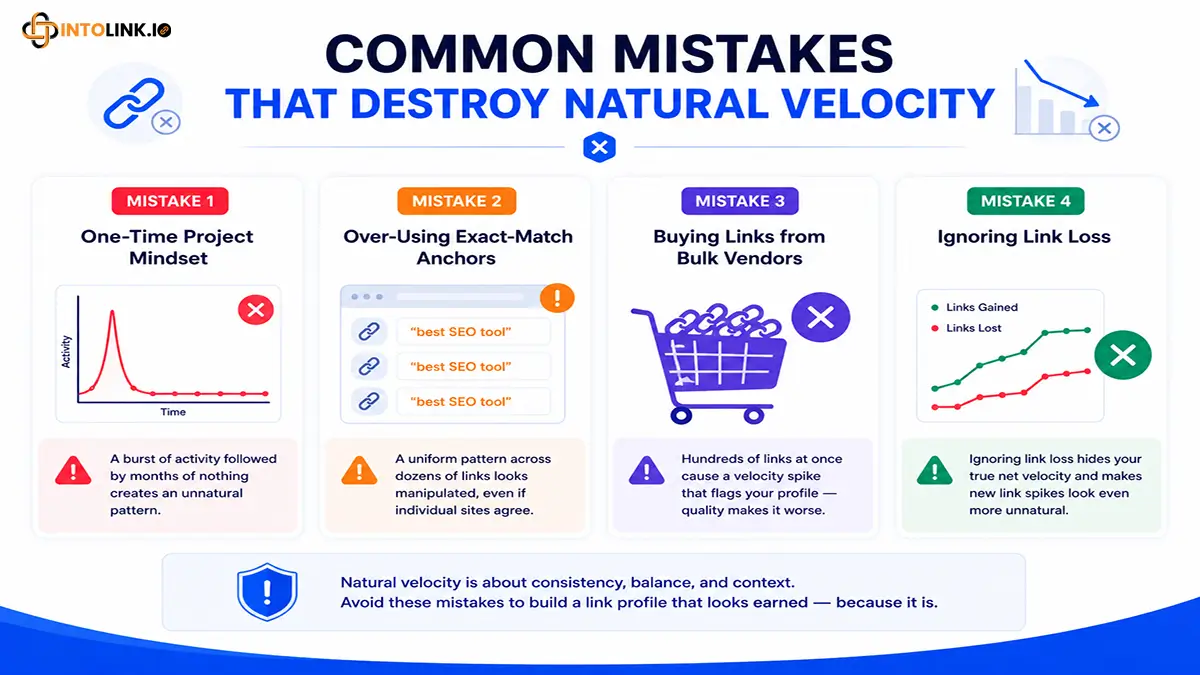
Which is given below for your convenience of understanding.
Mistake 1: Treating link building as a one-time project rather than an ongoing program. A burst of activity followed by months of nothing creates an unnatural pattern.
Mistake 2: Over-using exact-match keyword anchors in outreach-based link building. Even when individual sites agree to use your preferred anchor, a uniform pattern across dozens of links looks manipulated.
Mistake 3: Buying links from bulk vendors who deliver hundreds of links at once. The velocity spike alone is enough to flag your profile — the quality of those links makes the situation considerably worse.
Mistake 4: Ignoring link loss. Focusing only on acquisition while your existing links decay means your net velocity may be lower than you realize, and a sudden burst of new links creates an even sharper spike relative to your actual baseline.
What to Do If You Have Already Triggered an Unnatural Velocity Penalty?
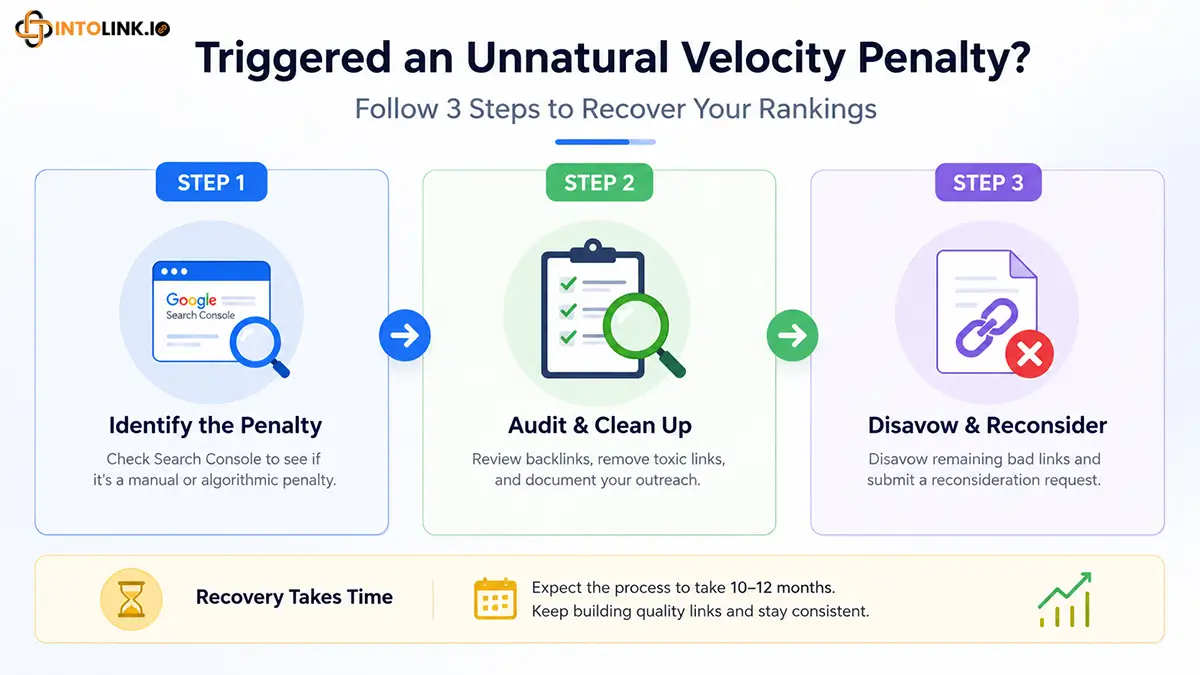
Recovery requires three sequential steps: identifying whether the penalty is manual or algorithmic, conducting a thorough backlink audit and cleanup, and then filing a disavow file or submitting a reconsideration request. This process typically takes 10–12 months to complete.
Step 1. Identify Whether You Have a Manual or Algorithmic Penalty
The first thing to check is Google Search Console under Security and Manual Actions > Manual Actions. If Google has issued a manual penalty for unnatural links, it will appear there with a description. This is the easier scenario to address because you know exactly what you are dealing with.
If your traffic dropped sharply following a core algorithm update but Search Console shows no manual action, you are likely dealing with an algorithmic penalty—typically connected to Penguin or SpamBrain. These are harder to diagnose but respond to the same cleanup process.
Step 2. Conduct a Backlink Audit and Clean Up
Export your full backlink profile from Ahrefs or Semrush and systematically evaluate each referring domain. Flag any links that come from:
- Irrelevant niches with no topical connection to your site
- Domains with very low authority or high spam scores
- Known link networks, PBNs, or directories that exist purely for link selling
- Foreign-language sites with no obvious reason to link to you
For each flagged link, reach out to the webmaster requesting removal. Document every outreach attempt the date, the contact used, and the response. This documentation becomes essential if you need to file a reconsideration request.
Step 3. Disavow and Submit a Reconsideration Request
For links you cannot get removed through direct outreach, compile a disavow file in Google’s required format and submit it through Google Search Console’s Disavow Links tool.
If you received a manual action, once cleanup is complete, submit a reconsideration request through Search Console. Be specific and honest about what happened, what you did to fix it, and what systems you have put in place to prevent it from recurring.
Important: Recovery is slow. On average, recovering from a significant unnatural links penalty takes 10–12 months sometimes longer for severe cases. Consistent, clean link acquisition during the recovery period is the best thing you can do to accelerate the process.
Natural Link Velocity in 2026 — What Has Changed?
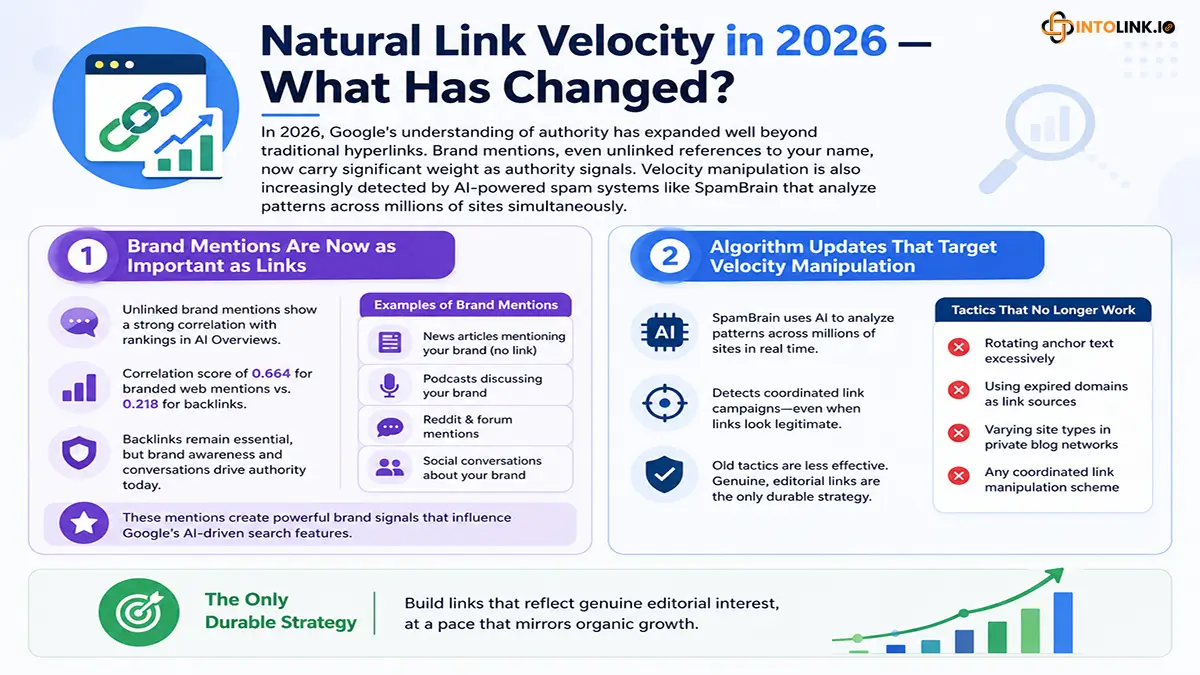
In 2026, Google’s understanding of authority has expanded well beyond traditional hyperlinks. Brand mentions, even unlinked references to your name, now carry significant weight as authority signals. Velocity manipulation is also increasingly detected by AI-powered spam systems like SpamBrain that analyze patterns across millions of sites simultaneously.
Brand Mentions Are Now as Important as Links
One of the most significant shifts in recent search research is the growing correlation between unlinked brand mentions and rankings in AI Overview results. Analysis found a correlation score of 0.664 for branded web mentions—compared to just 0.218 for traditional backlinks.
This does not mean backlinks are irrelevant; they remain essential. But it does mean that building genuine brand awareness and getting people and publications to talk about your brand even without a hyperlink is now a meaningful part of the authority equation.
For the link velocity strategy, this matters practically: some of your best “link building” efforts may not produce traditional links at all. A journalist who mentions your research without linking to it, a podcast host who discusses your brand on air, a Reddit thread where your product comes up organically—all of these contribute to the brand signal that increasingly influences Google’s AI-driven search features.
Algorithm Updates That Target Velocity Manipulation
Google’s SpamBrain system, an AI-powered spam detection engine, has significantly improved its ability to identify coordinated link campaigns. Unlike earlier, rule-based systems that could be gamed by varying tactics, SpamBrain analyzes patterns across enormous datasets and can identify manipulation even when individual links look legitimate in isolation.
The practical implication: tactics that worked two or three years ago, rotating anchor text, using expired domains as link sources, varying the types of sites in a private blog network are substantially less effective at evading detection today. The only durable strategy is the one that has always been true in principle but is now enforced with far more precision: build links that reflect genuine editorial interest, at a pace that mirrors organic growth.
CONCLUSION
Natural link velocity focuses on consistency, variety, and authenticity rather than speed or excessive caution. Websites that achieve long-term SERP success build natural link profiles through gradual growth and regular content publication. Varying anchor text and obtaining links from diverse sources indicate true popularity and engagement. Genuine efforts should inspire others to write about your site, while deceptive practices may yield quick ratings but ultimately harm traffic quality. Sustained, ethical practices lead to compounding traffic benefits over time.
BONUS: QUICK REFERENCE CHEAT SHEET
| Factor | Healthy Signal | Red Flag |
| Monthly Referring Domains | Gradual, consistent growth | Sudden 3x+ spike in a single month |
| Anchor Text Distribution | Mixed—branded dominant (40–50%) | 80%+ exact-match commercial terms |
| Link Source Diversity | Blogs, news, directories, social | All from one source type |
| Dofollow / Nofollow Ratio | Approximately 70/30 split | 100% dofollow—no nofollow at all |
| Link Quality | Topically relevant, established | Low-authority or spammy sites |
| Velocity Spikes | Tied to a PR event or launch | Unexplained, no editorial reason |
| Brand Mentions | Growing organically across the web | Zero brand mentions despite links |