
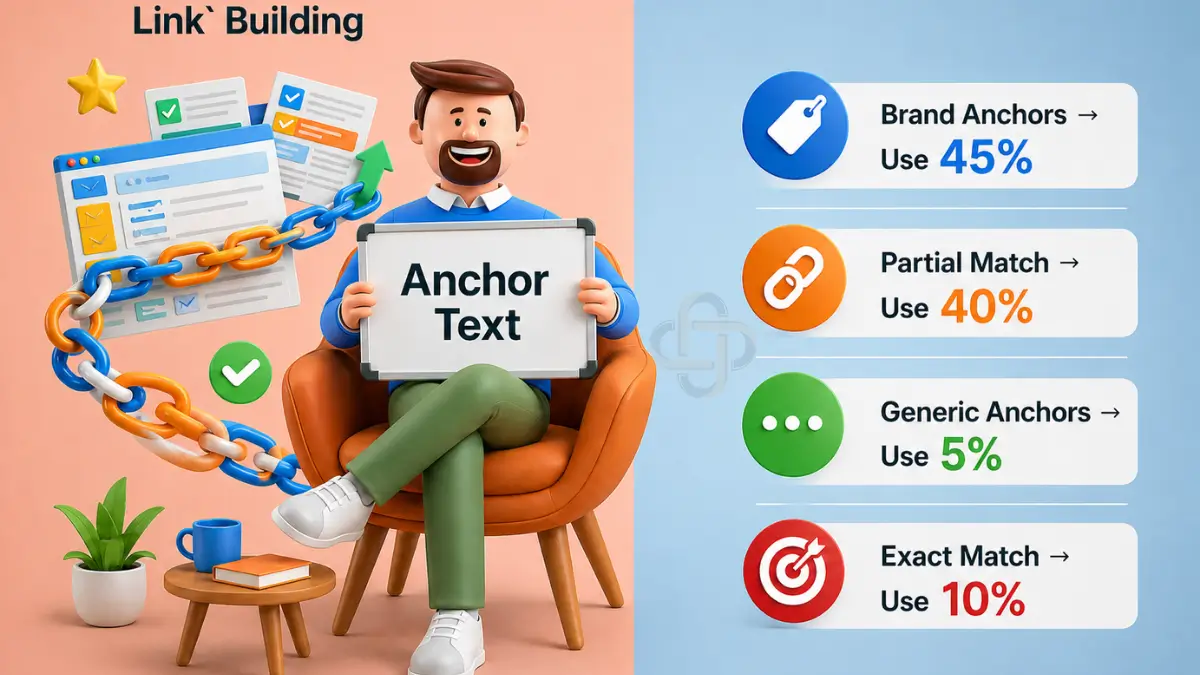
The safest and most effective anchor text ratio for link building in 2026 is: 45% brand anchors, 40% partial match, 10% exact match, and 5% generic anchors. This balanced approach keeps your backlink profile natural and helps avoid Google penalties while improving rankings.
Why Does Anchor Text Strategy Matter More Than Backlinks for Ranking?
Link Building / Backlinks is a very important part of SEO. Everyone already knows that. However, the biggest mistake we often make while creating backlinks is in the use of Anchor Text. We mainly rely on anchor text when building backlinks.
Just as proper anchor text plays a vital role in ranking a website, using it incorrectly can cause the most damage to website rankings and may even be counted as spam backlinks.
Among many SEO practitioners, the most common mistake is overusing Exact Match Keywords as anchor text. For example, if your target keyword is “Best SEO Expert,” many people build all their backlinks targeting that exact keyword. They repeatedly use the same keyword as anchor text for every link. This practice is called using an Exact Match Keyword.
If your backlink profile contains too many Exact Match Keywords, it does not look natural to Google. Instead, Google may consider it spammy behavior.
Therefore, when using anchor text, we must always ensure that our backlink profile looks natural and diversified.
There are basically 4 types of Anchor Text:
- Brand Anchors → Use 45%
- Partial Match → Use 40%
- Generic Anchors → Use 5%
- Exact Match → Use 10%
Brand Anchors:
These are your brand or website names, such as Intolink. Their type of anchor text is the safest and most natural. In the current era of AIO, Brand Anchors play the most important role. They help build trust, authority, and brand identity, which supports faster website growth. When people and search engines see your brand name consistently, your credibility increases naturally. In this case, Digital PR campaigns and Press Release Distribution are highly effective strategies. So, in modern link building, using around 45% Brand Anchors to build your brand is considered the best and safest strategy.
Partial Match:
These anchors usually contain a keyword + brand name or a related phrase (example: “SEO Service Intolink”). It means combining your target keyword with your website name, which represents your brand. This type of anchor text helps Google understand the topic of your website, while still looking natural and not overly optimized. At the same time, it strengthens your brand identity alongside your keywords. As a result, this approach creates a perfect balance between keyword relevance and brand authority, which is essential for steady and sustainable ranking growth.
Generic Anchors:
These are generic words such as “Click Here,” “Learn More,” and “Visit Website.” These types of anchor texts make your backlink profile look more human and natural, which Google highly prefers. However, personally, Intolink Suggests use them very sparingly only around 5% to maintain a balanced and natural link-building strategy.
Exact Match:
These are exact target keywords (for example: “SEO Service”). Suppose you have a page whose targeted keyword is SEO Service. Now, when you create a backlink, you write content and use that same keyword as the anchor text. This is what we call an Exact Match Anchor Text.
In 2026, using too many exact match anchors can be seen by Google as over-optimization or a spam signal. If you check your backlink profile using tools like Semrush, you will often notice that these types of backlinks are marked as Money Keywords, meaning they are highly commercial and sensitive from an SEO perspective.
That’s why in the current SEO landscape, it is better to avoid excessive use of Exact Match Anchor Text, and using no more than 10% is generally considered a safe and effective practice.
Conclusion
Having many links is not as important as having a well-planned strategy and building backlinks only when necessary. A website can perform much better with a smart, structured approach rather than random link building.
So remember, Link Building is not about building links randomly; it is a strategic process. Real success in SEO comes when you can maintain a natural and balanced anchor text strategy that builds trust, authority, and long-term ranking stability.
FAQ About Anchor Text In Link Building
Exact match vs branded Anchor — which one is actually safe and powerful?
Branded anchors are the safest and most powerful option for long-term SEO because they create a natural linking pattern and help increase your site’s trust, authority, and brand identity—factors that Google views very positively. On the other hand, exact match anchors can provide faster ranking signals, but excessive use may lead to over-optimization and trigger spam signals. Therefore, the best practice is to use more branded anchors and keep exact match anchors very limited (around 5–10%). This approach helps maintain a natural backlink profile and allows your rankings to grow safely and sustainably over time.
Can Google penalize you for using the wrong Anchor Text?
Yes, using the wrong anchor text can increase the risk of a Google penalty or a ranking drop. If you use one word or phrase as the anchor text but link it to a completely different page, it can be misleading for visitors. Google may interpret this behavior as a spam signal. In most cases, this does not result in a manual penalty. Instead, it usually works as an algorithmic filter, where your rankings gradually decline or fail to improve because the backlink profile appears unnatural or manipulative.
Can using too much Exact Match Anchor Text lead to a Google penalty or ranking drop?
Yes, it can happen. When you use too many exact match anchor texts (for example, repeating the same keyword again and again), Google may interpret this as an unnatural linking pattern or over-optimization. As a result, the value of your backlinks can decrease, and there is a higher risk of ranking drops for your targeted keywords.
However, in most cases, this does not lead to a direct manual penalty. Instead, the impact usually happens through an algorithmic filter, meaning Google may ignore the SEO value of those links rather than penalize your site outright.
Therefore, to maintain safe rankings, it is best to use a natural and balanced anchor text profile (brand + partial + limited exact match).
Does the success of link building in SEO depend entirely on anchor text?
No, the success of link building in SEO does not depend entirely on anchor text. Anchor text is definitely important because it helps Google understand the topic of a page, but it is only one factor among many.
Real ranking success depends on several other elements—such as the quality of backlinks, the authority of the referring domain, relevancy, and maintaining an overall natural link profile. Even a very strong backlink may fail to deliver good results if it comes from the wrong context or a low-quality website.
Therefore, while anchor text is important, it cannot control rankings on its own. A balanced strategy, combined with high-quality backlinks and strong relevancy, is what truly drives SEO success. However, using incorrect or over-optimized anchor text can make your entire backlink profile look unnatural, which may lead to ranking drops or loss of SEO value.
Why does the same backlink give different ranking results when the anchor text is changed?
Even with the same backlink, the ranking impact can be different if the anchor text changes, because Google uses anchor text as a context signal. Anchor text helps Google understand which topic or keyword the linked page is relevant to.
If the anchor text is more relevant and natural (such as a brand name or partial match), Google is more likely to treat it as a trustworthy and organic signal, which can lead to a stronger ranking boost. However, if the anchor text is irrelevant or over-optimized, the value of that same backlink may decrease or be considered a weaker signal.
So, the difference is not really in the backlink itself, it depends on the relevance, naturalness, and level of optimization of the anchor text.
Do backlinks alone help rankings, or is anchor text the real game-changer in SEO?
Getting backlinks does not guarantee rankings on its own—it is simply one ranking signal. Google does not look only at the number of links; it also analyzes the quality, relevance, authority, and context of those links.
Anchor text plays an important role because it helps Google understand which topic a page is relevant to. However, calling it a “game changer” would not be completely accurate, because rankings cannot be controlled by anchor text alone.
Real SEO success comes from a balanced combination of high-quality backlinks, natural anchor text, relevant context, and strong content working together.