
Consider two numbers side by side: 96.55% of all web pages have zero external backlinks, yet the #1 ranking result on Google typically has 3.8x more backlinks than pages sitting in positions 2 through 10. That gap hasn’t closed in 2026 — if anything, it’s widened, because the rules for which links count have gotten stricter.
Link building isn’t dead. It’s been reshaped—pushed away from volume and toward relevance, editorial trust, and machine-readable authority. Between Google’s core and spam updates, the rise of SpamBrain, and the growing influence of AI Overviews and generative search, the way links are earned, evaluated, and rewarded has fundamentally shifted. This guide breaks down exactly what changed, backs it with current market data, and lays out what actually works now, and what’s likely to keep working as AI search matures.
The Link Building Market by the Numbers (2026)
Before getting into the “why,” it’s worth understanding the scale of what’s at stake. Despite predictions that AI would kill link building, the market is doing the opposite of shrinking.
Market Size & Growth
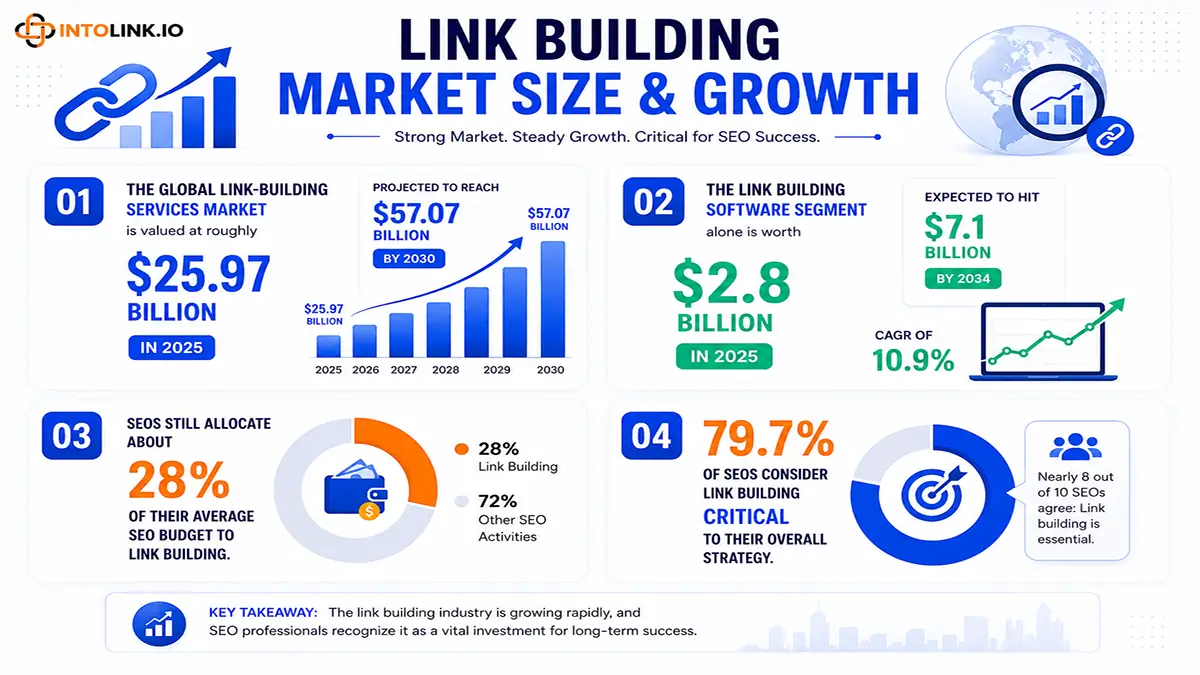
- The global link-building services market is valued at roughly $25.97 billion in 2025, projected to reach $57.07 billion by 2030.
- The link building software segment alone is worth $2.8 billion in 2025, expected to hit $7.1 billion by 2034 — a CAGR of 10.9%.
- SEOs still allocate about 28% of their average SEO budget to link building.
- 79.7% of SEOs consider link building critical to their overall strategy.
Spending & Sentiment Shift
- 56% of link builders plan to increase investment over the next 12 months.
- Only 9% plan to decrease budget because of AI-driven search changes.
- 48.6% now consider Digital PR the most effective link-building tactic — overtaking traditional guest posting.
Average cost per link by Domain Rating (DR) tier:
| DR Tier | Typical Cost per Link |
| DR 20–40 | $130 – $220 |
| DR 40–60 | $220 – $400 |
| DR 60–80 | $400 – $700 |
| DR 80+ | $700 – $1,200+ |
The takeaway: Link building isn’t shrinking, it’s consolidating around quality. Budgets are moving toward fewer, higher-value placements instead of large volumes of cheap links.
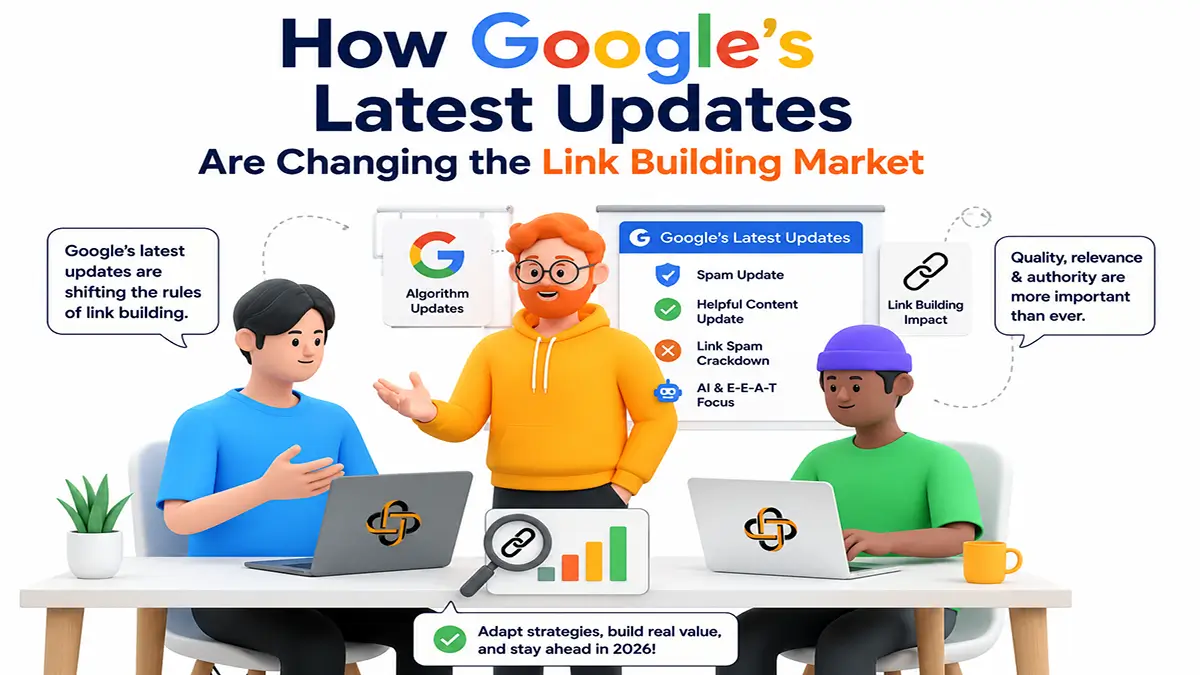
Which Google Updates Actually Reshaped Link Building?
Several distinct updates have compounded over the past two years to get the market here.
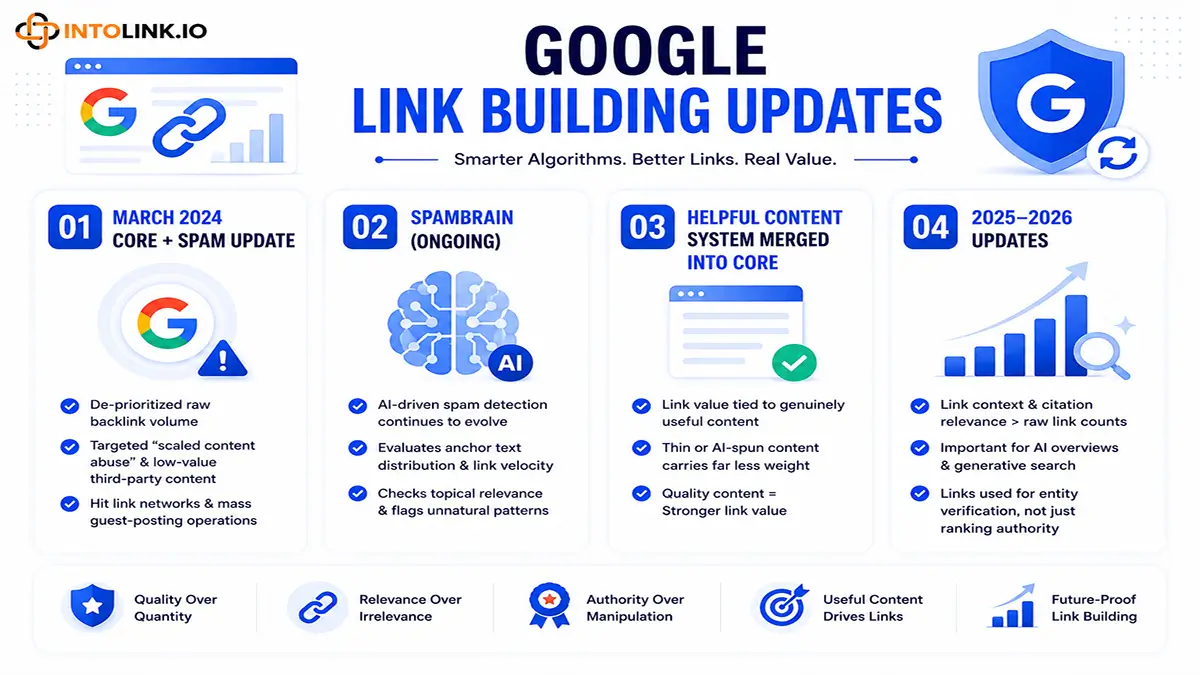
March 2024 Core + Spam Update: Widely considered the biggest turning point. Google officially de-prioritized raw backlink volume as a ranking signal and introduced policies targeting “scaled content abuse” and low-value third-party content—directly hitting link networks and mass guest-posting operations that relied on churning out content purely to host links.
SpamBrain (ongoing, AI-based): Google’s AI-driven spam detection system continues to evolve. It evaluates anchor text distribution, link velocity (how fast links to a domain appear), and whether linking content is topically relevant—flagging unnatural patterns that used to slip through manual review.
Helpful Content System Merged Into Core: Link value is now tied more tightly to whether the surrounding content is genuinely useful. A link sitting inside thin, AI-spun filler content carries far less weight than the same link inside a well-researched, original piece.
2025–2026 Updates: As AI overviews and generative search results have expanded, link context and citation relevance have become more important than raw link counts. Google (and AI systems more broadly) increasingly use links as signals for entity verification, not just ranking authority.
From Quantity to Quality — What Actually Changed?
What does Google reward now?
Contextual relevance between linking and target content: The linking page’s topic should genuinely relate to the page it links to. A cooking blog linking to a kitchenware review feels natural—a random tech directory linking to it doesn’t.
Editorial placement—links that fit naturally within the narrative: The link should sit inside real, flowing content—placed there because it adds value to what’s being discussed, not dropped in artificially or listed separately.
Real audience engagement and click-through on the link: If real readers on the linking page actually click through and engage, it signals to Google that the link serves genuine user interest, not just a hidden ranking signal.
Topical authority and trust of the linking domain: A link from a site that’s already recognized and trusted within your niche carries far more weight than one from a generic, unrelated, or low-authority domain.
What Google Actively Penalizes?
Paid links without disclosure: Buying a link and not marking it with rel=”sponsored” or nofollow violates Google’s guidelines — undisclosed paid links are treated as manipulative, regardless of content quality.
Private blog networks (PBNs): Networks of sites built solely to host and pass links to a target site. Google actively hunts for PBN patterns (shared hosting, similar templates, no real audience) and devalues or penalizes them.
Automated or scaled link schemes: Any system that generates or places links in bulk without genuine human editorial judgment, this is exactly the pattern SpamBrain is built to detect.
Low-quality guest post networks operating at scale: Groups of sites that exist mainly to publish thin guest content in exchange for links. The lack of real editorial standards makes this pattern easy for Google to flag.
Irrelevant outbound linking that doesn’t serve the reader: Links placed on a page purely for SEO purposes, with no real connection to what the reader is looking for; these fail the basic “does this help the user” test Google applies.
Before vs. After: The Shift at a Glance
| Old Approach | New Approach |
| Volume of backlinks | Relevance & context |
| Exact-match anchors | Natural, varied anchors |
| Mass guest posting | Digital PR & thought leadership |
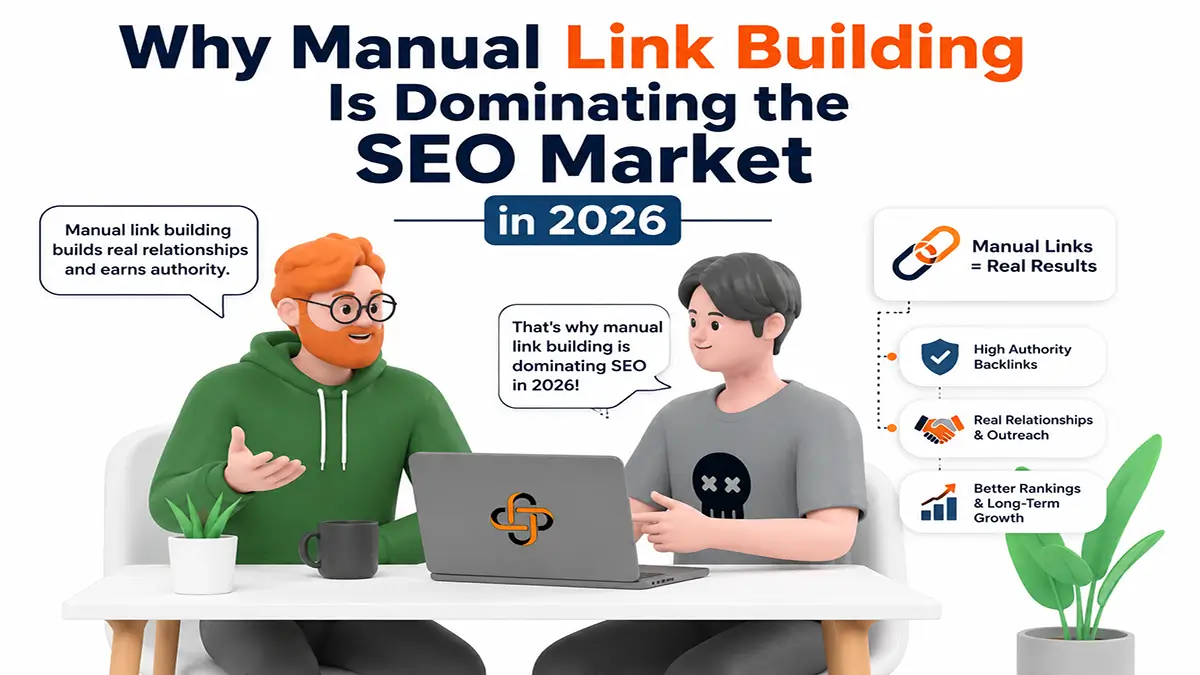
| Buy links in bulk | Earn editorial mentions |
How does AI (SpamBrain & Beyond) Evaluate Links Today?
Modern link evaluation is far more granular than a simple “count the backlinks” model. Google’s AI systems weigh several signals simultaneously:
- Anchor text naturalness: Does the anchor read like something a human would actually write?
- Link velocity: How quickly new links are accumulating, and whether that pace looks organic
- Contextual fit: Whether the link makes sense within the surrounding paragraph
- Linking domain’s topical relevance: A link from a niche-relevant site carries more weight than one from an unrelated domain
- User engagement signals: Click-through rate and dwell time on the linking page
- Historical trust score: The linking domain’s track record over time
E-E-A-T and Brand Signals Are Now Part of Link Value
Google’s E-E-A-T framework (Experience, Expertise, Authoritativeness, Trustworthiness) has become deeply intertwined with how links are valued.
- Author credibility now factors into how a link is evaluated — a byline from a recognized expert adds weight.
- Brand mentions, even without a hyperlink, contribute to authority and entity-recognition signals.
- First-hand experience content — case studies, original testing, real data — tends to earn more natural, unsolicited links.
- Content depth and demonstrated expertise increase the effective “weight” of any link pointing to it.
This is a meaningful shift: a brand mentioned by name in a respected publication, even with no clickable link, can now contribute measurable authority—which leads directly into the next shift.
Link Building in the Age of AI Search & Generative Engines (GEO)
This is where the market is heading, and it’s the area most competitors are covering only in passing.
- AI Overviews and AI-generated search summaries still lean on trustworthy, well-linked sources to construct their answers.
- Links help AI systems verify facts and map relationships between entities — not just pass “authority” the way traditional PageRank did.
- Unlinked brand mentions and citations are becoming nearly as valuable as traditional backlinks, as entity-based SEO grows in importance.
- 73.2% of SEO professionals still believe backlinks influence AI search results, despite the shift toward generative answers.
- Original research, proprietary data studies, and expert quotes are cited by AI systems far more often than generic, recycled content.
In practical terms, if your content isn’t original enough to be worth citing, it’s less likely to show up in an AI-generated answer, regardless of how many backlinks it has.
Strategies That No Longer Work
Mass directory submissions: Submitting your site to hundreds of generic, low-quality directories just to grab a link. Google has long stopped valuing these, most carry no real relevance or traffic, so they add no ranking benefit and can look like a manipulative pattern.
Low-quality guest posting at scale: Publishing dozens of thin, templated guest posts across unrelated sites purely to place links. SpamBrain easily detects this scaled pattern, and the sites hosting them are usually low-authority themselves, so the links carry little to no value.
Reciprocal link exchanges: “I’ll link to you if you link to me” arrangements. Google explicitly flags excessive reciprocal linking as a link scheme, it’s an obvious signal that links are being traded rather than earned.
Footer or sidebar spam links: Links stuffed into a site’s footer or sidebar, often unrelated to the page content. These sit outside the actual editorial content, so they carry very little contextual relevance and are an easy spam signal to spot.
Irrelevant niche backlinks bought purely for volume: Buying links from unrelated-niche sites just to increase your total backlink count. Since the linking site has no topical connection to your content, the link doesn’t reflect genuine relevance and can actually raise penalty risk.
Exact-match anchor text stuffing: Repeatedly using your exact target keyword as anchor text across many links. This unnatural pattern is one of the clearest algorithmic red flags—real, organic links use varied, natural anchor text instead.
What Works Now (and Will Keep Working)?
High-value, original content—data studies, first-hand experience, proprietary research: Publish your own original data, surveys, or case studies. Other sites naturally cite and link to this kind of content because it can’t be copied from anywhere else—it’s a unique source.
Digital PR and journalist outreach (HARO-style expert commentary): Provide expert quotes or commentary in response to journalist queries. This earns high-authority editorial links from news and magazine sites—links that can’t be bought, which is exactly why they carry more trust.
Editorial, contextual guest contributions on genuinely relevant sites: Instead of mass guest posting, contribute well-written content only to topically relevant sites with a real audience. The link fits naturally within the content rather than feeling forced.
Deliberate brand-mention building, both linked and unlinked: Not just backlinks—even mentions of your brand name without a link (in reviews, forums, and news articles) build entity authority. AI search systems now factor these unlinked mentions in too.
Diversifying trust signals — social proof, reviews, community mentions: Don’t rely on backlinks alone. Maintain a presence on Reddit, Trustpilot, Google Reviews, and community discussions (like Quora)—this reinforces overall brand trust from multiple directions.
Ongoing link audits to catch and disavow toxic links before they cause damage: Regularly review your backlink profile to identify spammy or toxic links and disavow them, so a handful of bad links don’t drag down your entire site’s rankings.
Industry-Specific Insights
Link-building difficulty and spend vary significantly by industry:
- iGaming/betting requires the biggest link-building budgets of any vertical.
- Easiest niches to build links in: beauty, marketing/PR, and leisure/sports.
- Hardest niches: healthcare, accounting, and legal — largely due to regulatory sensitivity and less inherently shareable subject matter.
- The legal industry spends the most per link on average, reflecting both difficulty and high customer lifetime value.
If your brand operates in a regulated or “dry” niche, expect to invest more per link — and lean harder into digital PR and original research to earn coverage naturally.
How Businesses and Brands Should Adapt?
- Audit your existing backlink profile — identify and disavow toxic or spammy links.
- Shift budget from bulk guest posts toward digital PR and original content that earns coverage organically.
- Invest in E-E-A-T signals — verified author bios, case studies, and original data.
- Track quality metrics, not just link count—referring to domain relevance, engagement, and topical fit matter more than raw numbers.
- Build brand mentions across AI-visible sources—Reddit, forums, review sites, and niche publications increasingly feed AI search summaries.
Frequently Asked Questions
Is link building dead in 2026?
No. The market is growing (projected to nearly double by 2030), but the tactics that work have changed significantly—quality, context, and editorial trust now outweigh volume.
Do backlinks still matter for AI search (AI Overviews)?
Yes. Most SEO professionals still believe backlinks influence AI-generated search results, and links continue to help AI systems verify facts and understand entity relationships.
How many backlinks do I need to rank?
There’s no fixed number. Relevance, context, and the authority of linking domains matter far more than a specific count.
What is SpamBrain?
Google’s AI-based spam detection system, which evaluates anchor text patterns, link velocity, and contextual relevance to identify manipulative link schemes.
Is guest posting still safe?
Yes, when done judiciously on genuinely relevant, editorially operated sites with original information, rather than on a large scale just to place connections.
Conclusion
Google did not destroy link building; it killed shortcuts. Backlink volume, exact-match anchors, and mass guest posting have been replaced with relevance, editorial trust, E-E-A-T signals, and digital public relations. As AI Overviews and generative search evolve, brands that invest in original,
If you’re not sure where your current backlink profile stands, an audit is the logical first step before shifting your strategy or budget.