
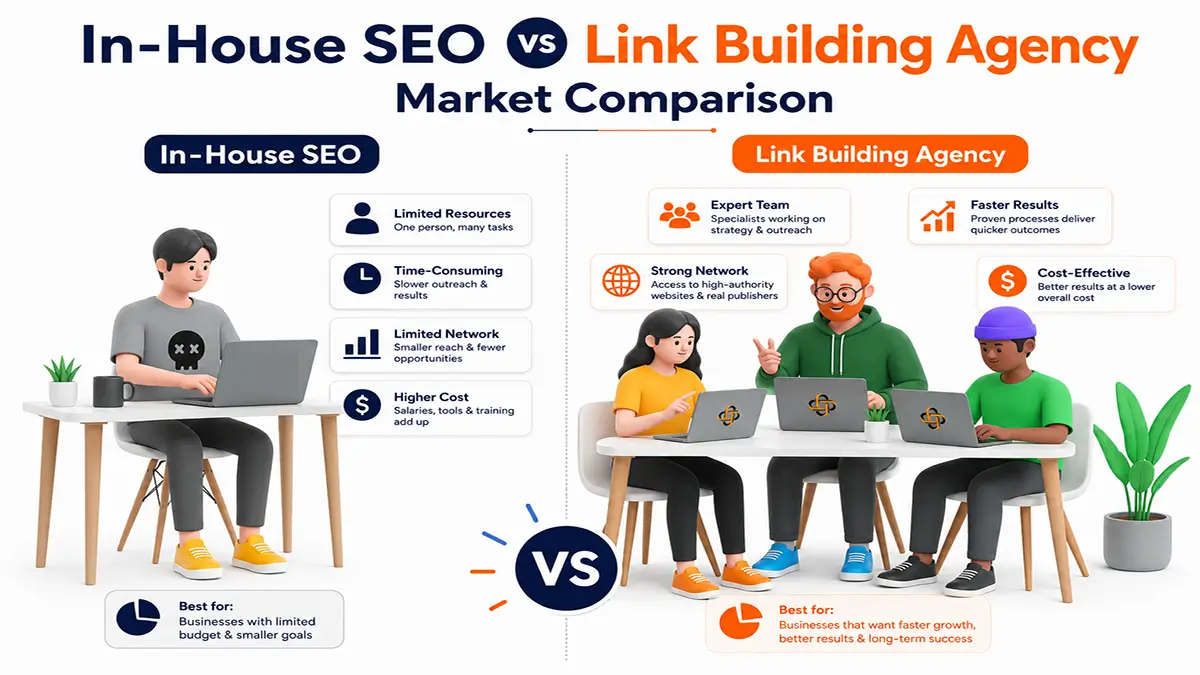
This isn’t really a “which is better?” question—it’s a trade-off between speed, cost, and scalability. Most businesses get this decision wrong because they only compare a salary number against a retainer fee. The real picture is much bigger: hidden turnover costs, tool subscriptions, recruitment time, and how long it actually takes to see results all factor into the true cost.
In this guide, you’ll learn the true cost analysis, the speed differences, the return on investment figures, and when the hybrid approach makes sense. The core idea: this is control vs. scalability, speed vs. alignment—and the right answer depends entirely on where your business is right now.
What Is In-House SEO vs Link Building Agency—A Quick Breakdown?
What Is In-House SEO?
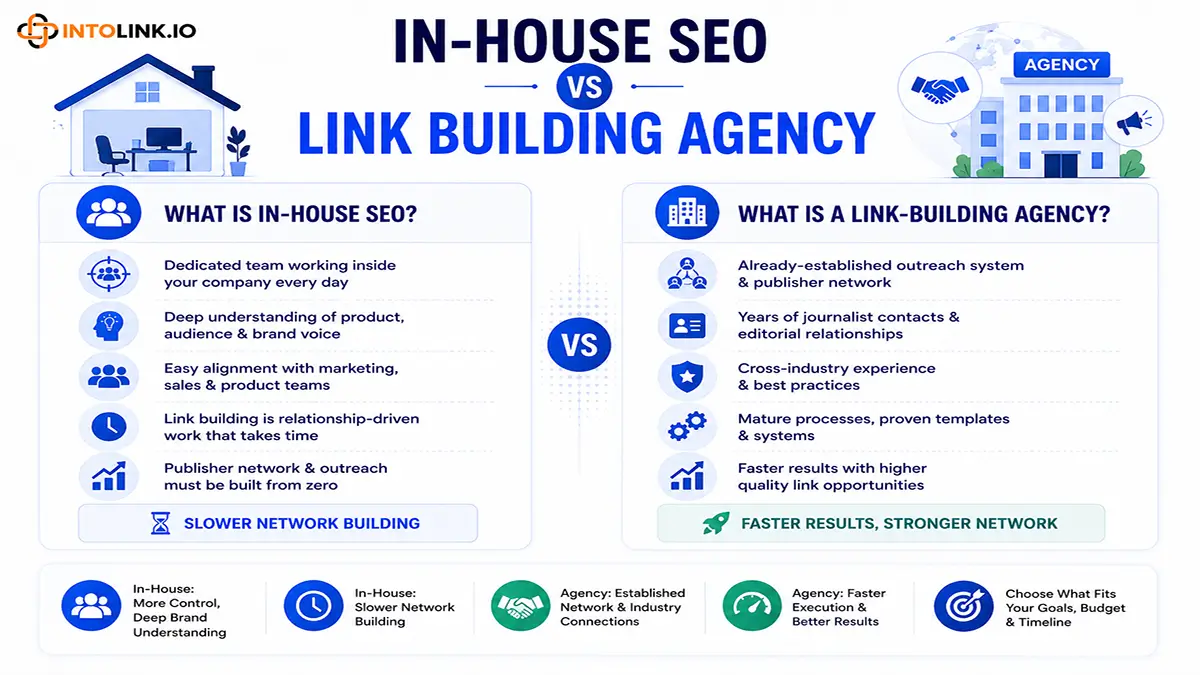
In-house SEO means your company’s own dedicated team, working inside the business every day. They understand the product, the audience, and the brand voice better than anyone, and they can align easily with other departments like marketing, sales, or product. But link building is relationship-driven work, the publisher network, outreach contacts, and editorial relationships take time to build. An in-house team essentially has to build this network from zero, which is a slow process.
What Is a Link-Building Agency?
A professional link-building agency comes with an already-established outreach system, years of built-up publisher relationships, journalist contacts, and cross-industry experience. Since this is literally their day-to-day work, their process, templates, and results all run on a mature system that a brand-new in-house team simply doesn’t have yet.
Real Cost Comparison — The Numbers (2026 Data)
Cost is the single biggest factor in this decision, but most businesses only look at the salary figure and never see the full true cost before deciding.
The Real Annual Cost of an In-House SEO Team
According to Glassdoor and LinkedIn Salary Insights, a functional in-house SEO team typically needs these roles:
| Role | Annual Salary (US average) |
| SEO Manager | $85,000–$130,000 |
| Content Writer/Strategist | $55,000–$85,000 |
| Technical SEO Specialist | $75,000–$115,000 |
| Link Building/Digital PR Specialist | $50,000–$80,000 |
| 4-person team base salary total | $265,000–$410,000/year |
But that’s not the full picture. On top of base salaries, add:
- Benefits and payroll tax, typically 25–35% of base salary
- SEO tool subscriptions, Ahrefs, Semrush, Screaming Frog combined run $15,000–$40,000/year
- Recruitment cost, industry benchmarks put this at roughly $4,700 per hire
- Training and onboarding time, the ramp-up period before a new hire is fully productive
Add it all up, and a full in-house SEO team’s true cost lands at $250,000–$500,000+ per year.
The Cost of a Link Building Agency
By comparison, a link building agency retainer typically runs $1,000–$7,500/month, depending on business size and scope. For that same budget, you get an entire specialist team—technical SEO, content, link building, and now AEO/GEO expertise, all at once, without hiring each role separately.
Quick Comparison Table
| Factor | In-House Team | Agency |
| Annual cost | $250K–$500K+ | $12K–$90K ($1K–$7.5K/month) |
| Setup time | 6–12 months | A few weeks |
| Expertise breadth | Limited to team’s skill set | Cross-industry, full-stack |
| Turnover risk | High (relationship loss risk) | Low (agency owns the network) |
| Speed of results | Slow | Comparatively fast |
The Hidden Cost of Turnover — Why In-House Link Building Is Riskier
This is a piece most competitor content barely touches, but it’s a real factor in the decision.
When a link builder leaves, the publisher relationships and personal network they built leave with them. It’s not something that transfers cleanly like a spreadsheet, a new hire essentially has to start rebuilding those relationships from scratch.
Calculated over a 3-year window, the blended “cost per link” — factoring in turnover — often ends up higher for in-house teams than for agencies, because every time a new hire comes in, outreach effectiveness resets to near zero. A full-time outreach specialist typically sends 350–500 outreach emails a week just to land around 15 quality backlinks, and that effort has to be rebuilt from scratch every time an in-house team turns over. That’s a hidden but very real cost.
Speed and Scalability — Who Delivers Results Faster?
Agencies deliver results faster. They start from an already built system, while an in-house team has to build that system first—and that head start is what shows up in the numbers.
The Reality of In-House
A new in-house team starts with relationship-building. Outreach success rates are typically low for the first several months, since there’s no established trust or prior contact to lean on. As a result, measurable results usually take many months to show up — the first quarter or two is largely spent on groundwork, not link placements.
The Reality of Agencies
A professional agency already has templates, contact lists, and a trained outreach team ready to go, so link placements can start within the first month. Industry benchmarks suggest outsourced SEO campaigns deliver roughly 3x more ROI than in-house efforts, thanks to specialized teams and faster execution on an already-optimized process.
The Bottom Line
If speed is the priority—you need links landing this quarter, not next year—an agency wins hands down. In-house only closes this gap once the team has had a year or more to build its own relationships and workflow. So the honest way to frame it is that agencies win on speed early on; in-house can catch up over time but rarely overtakes agency turnaround unless the team stays intact for years.
Expertise and Authority Signals in the Age of AI Search (AEO/GEO)
Google AI Overviews, SGE, and LLM citations no longer just measure content volume — they weigh authority and entity recognition.
This is where agencies have a clear edge. Agencies can start working on AEO (Answer Engine Optimization) and GEO (Generative Engine Optimization) almost immediately, since they already have the skills and experience. An in-house team, by contrast, typically needs 6–12 months to develop this capability from scratch.
Editorial mentions and contextual backlinks now matter not just for traditional search rankings but equally for visibility inside AI-generated summaries and recommendations.
Control vs. Expertise—The Real Trade-Off
In-house means full control, brand familiarity, and tight internal alignment. Agency means specialization, speed, a broader network, and cross-industry insight.
The key point: these aren’t competing ideas. Plenty of successful businesses today use both at once, leaning on each one’s strength where it matters most.
The Hybrid Model—The Most Popular Approach in 2026
The biggest trend in 2026 is the hybrid model, and nearly every strong piece of competitor content touches on it. In this setup, strategy and brand alignment stay in-house, while execution, link building, and outreach go to a specialist agency. This combines the best of both worlds.
Hand data-heavy prospecting and analysis to AI or an agency while keeping personal relationship-building and high-level strategy in-house.
In simple terms, let your team own content and brand voice, and let a specialist agency handle outreach and link acquisition.
Which Business Should Choose What — A Scenario-Based Decision Framework?
Every business’s needs are different, so there’s no single universal answer. Use the scenarios below to figure out where your business fits.
When In-House SEO Is the Better Choice?
- You’re an early-stage startup with a tight budget but time to invest
- Your niche has relatively low competition
- Your business is primarily content-focused, and you’re patient enough for long-term internal learning
When an Agency Is the Better Choice?
- You’re competing in a nationally or globally competitive market
- You need fast results, or AEO/GEO visibility is a priority
- Annual revenue is under roughly $5M, making a full in-house team hard to afford
When a Hybrid Model Works Best?
- Your company is scaling and needs both brand alignment and specialized execution
- You already have an in-house team, but link building has become a bottleneck
A Real ROI Example (Simple Cost-Per-Link Calculation)
Numbers make the difference clearer. Say a 2-person in-house team costs $180,000/year in salary and brings in 50 backlinks. That works out to roughly $3,600 per link.
Compare that to an agency at $3,000/month ($36,000/year) delivering 40–50 quality links. That’s roughly $720–$900 per link.
Even this simple math shows agency cost-per-link can come in dramatically lower for similar output. Run this same calculation for your own business—compare what your team spends and delivers against a realistic agency output to see where you actually stand.
The Risks and Limitations of Each
Risks of In-House
- Talent scarcity, finding one person who’s strong across technical SEO, content, link building, and GEO is nearly impossible
- Narrow perspective — the team only sees its own company’s data, with less outside benchmarking experience
- High fixed cost — you’re paying full salaries even during slow periods with lower output
Risks of Agencies
- Less direct control and visibility into the outreach process
- Not all agencies are equal quality—vetting is essential to avoid shady link schemes
- Customization can be limited if an agency runs a generic, one-size-fits-all process
What to Check When Choosing a Professional Link Building Agency?
Before signing on with an agency, verify:
- They follow white-hat, Google-compliant practices
- They provide transparent reporting
- They have industry-specific experience and vetting
- They take a long-term, authority-focused approach rather than chasing short-term spikes
Frequently Asked Questions
If we have an in-house SEO team, can we skip link building?
No—link building is a core part of SEO. But you can keep the rest of SEO in-house while outsourcing just the execution to an outside specialist or agency.
Is an agency or a freelancer better for a small business?
It depends on scale and consistency. Freelancers can be cheaper but often have a smaller network and less structured reporting, while agencies typically bring a more structured process and a broader network.
When is the right time to transition from an agency to in-house?
When your link-building volume and budget grow large enough that a dedicated in-house hire becomes more cost-effective than an agency retainer, it’s worth considering the transition.
When starting a hybrid model, what should you hand to an agency first?
Data-heavy, relationship-driven work like outreach and prospecting is usually the best place to start with an agency, while strategy and brand voice stay in-house.
Final Thoughts
The real question isn’t “Which is better?”—it’s “Which one matches your growth stage and budget?” A small, low-competition-niche business can reasonably start with in-house SEO. But if you need speed, broad expertise, and predictable costs, an agency is usually far more effective. And in 2026, the smartest businesses are increasingly leaning toward a hybrid model — keeping brand control in-house while handing execution to specialists.
If you’re still unsure which model fits your business, book a free strategy call — we’ll look at your specific situation and help you map out the right path forward.